I was Director of the East Africa Hyperbaric Centre on Zanzibar from 2006 to 2008. Forty-odd recompressions in two years. The patients who concerned me most were not the tourists who'd gone too deep on a recreational dive and panicked on ascent. Those cases were straightforward.
The ones who concerned me were the men I never saw coming.
The sea cucumber divers of Mkokotoni — fishermen working the reef channel between the northwest coast of Unguja and the ancient ruins of Tumbatu Island — were diving four times a day, six days a week, to depths that by any standard decompression table constituted a mandatory decompression stop on every single dive. They had no training. No dive computers. No decompression tables. They had no concept of what the bends were, let alone that they were living inside a 7% daily probability of getting them.
They also had no idea where their tanks had come from.
// The EquipmentThe cylinders were US DOT-3AL 3000 PSI aluminium scuba tanks — recognisable by the certification stamp visible through the corrosion. They had come from somewhere. Of unknown provenance, as these things tend to be in a fishery where equipment circulates without paperwork. The recreational dive industry loses equipment. These tanks had found a second life, stored on bare ground between dives, filled by a petrol-driven compressor with no air filtration.
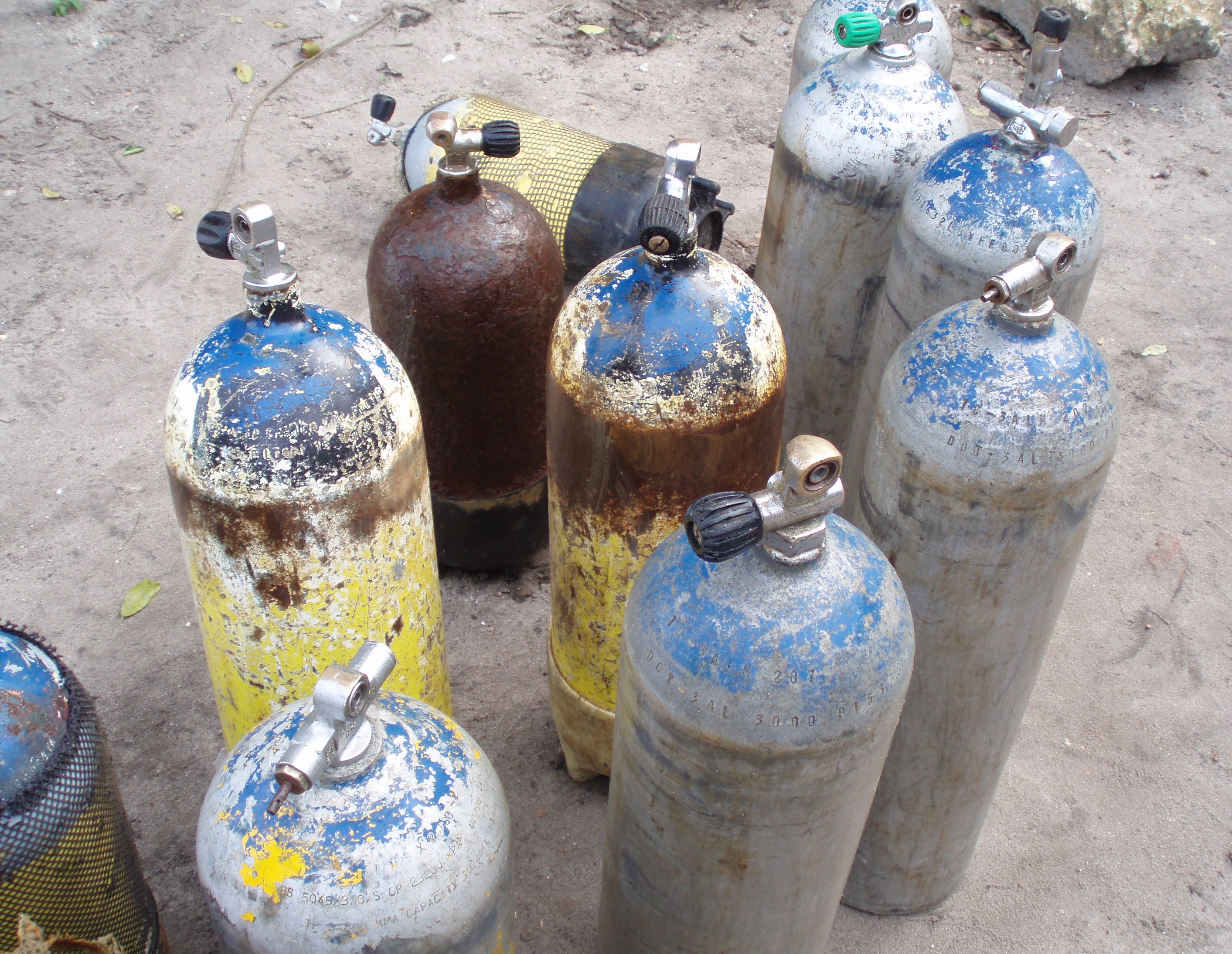
Cylinders of unknown provenance, varying states of corrosion, stored on bare ground. Several bear US DOT-3AL 3000 PSI certification stamps. None bore a current visual inspection sticker. Filled between dives by a petrol-driven compressor with no air filtration.
An unfiltered petrol compressor drawing air near its own exhaust produces carbon monoxide. The divers were breathing that too, at pressure, four times a day. They didn't know. There was no way for them to know. Carbon monoxide poisoning at depth presents as sudden unconsciousness — clinically indistinguishable from drowning.
Nobody drowned. That is either a testimony to extraordinary physiological resilience, or to luck, or to both.
// The PoniThey dived from the port of Mkokotoni for sea cucumbers of several kinds. The most valuable — and the one that took them deepest — was Actinopyga mauritiana, the surf redfish, known locally as the Poni.
In the global bêche-de-mer trade, the surf redfish is a low-value species. In the channel off Mkokotoni in 2007, it was worth sixteen US dollars a piece. An experienced Mkokotoni diver could make a hundred dollars in a day — fifty to a hundred times the local unskilled daily wage.
There was a reason it paid so well. There was only deep Poni left.
Actinopyga mauritiana is a shallow surf-zone species — typically found at one to three metres, accessible to anyone who can hold their breath. By the time I arrived, the shallow population had been commercially extinct for years. Chinese buyers had been operating along the Tanzanian coast since the late 1960s. The Mafia Island fishery collapsed in the 1990s. A national export ban followed in 2003. Trade continued through Zanzibar's semi-autonomous jurisdiction regardless.
What remained of the Poni was at thirty to thirty-eight metres — the extreme deep margin of the species' documented range — where it had survived only because getting there required scuba equipment. The divers had scuba equipment. Improvised, corroded, contaminated — but functional. So they went to thirty-eight metres, four times a day, with surface intervals averaging thirty-four minutes, and they came back up without stopping.
The documented DCS risk for the first full day of diving we recorded was 7.3%.
// The DataI fitted four of the divers with Sensus Pro depth-temperature recorders — small tags that log depth and water temperature every ten seconds. They wore them for two weeks in January 2007, plus a baseline session in November 2006. One hundred and ninety-seven dive files came off those four tags.
I sent the data to Petar Denoble at the Duke University Center for Hyperbaric Medicine and Environmental Physiology. He ran the profiles through the RS443GI probabilistic decompression risk model — the same tool used to assess Navy diving exposures. His email back was brief and precise.
"Estimating risk is 7%. Navy accepts risk of up to 2% and most dives in recreational diving are 1% or less. We have seen similarly high risks in several indigenous populations."
The graph he attached showed the cumulative DCS probability climbing with each successive dive and continuing to rise for hours after the last man surfaced — the slow compartment nitrogen that the body holds long after the pressure is gone.
Recorded DCS incidence in the dataset: zero out of one.
They weren't presenting because they didn't know what to look for. Joint pain after a day's diving is just joint pain. Fatigue is just fatigue. The language for decompression illness did not exist in their world.
// The NightsThe cucumber dives ran by day. The crayfish dives ran by night.
Diver 3835 — the most prolific of the four — accumulated two hundred and twenty-nine minutes of bottom time on the twenty-fifth of January 2007. Eight dives. Tropical crayfish (Panulirus spp.) after dark, sea cucumbers by day, a paraffin lamp burning on the dhow to draw the crayfish up from the dark water, a waxing gibbous moon climbing toward full, Tumbatu island a shadow on the horizon.
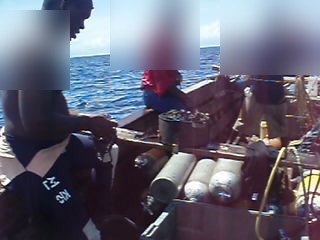
Cylinders racked along the gunwale, ready for the next dive. This is what the operation looked like from the water.
I have the Sensus data. The night dives are right there in the file, timestamped.
// The InterventionThe solution was not to stop them diving. That was never an option. A hundred dollars a day is not an option you take away from a man with a family to feed in Zanzibar in 2007.
The solution was a safety stop.
A pause on the way up — ten metres, two minutes — costs nothing. It costs no bottom time worth mentioning, no income, no extra equipment. It gives the nitrogen somewhere to go before the ambient pressure drops to one atmosphere and bubbles become the question.
I ran the training through the local PADI dive masters and instructors. About fifty divers came through. We taught the stop at ten metres rather than the standard recreational five — better suited to the depth profile of a Poni dive, more practical to execute on the way up through thirty metres of water column.
The divers had already taught themselves one thing without being told. Their average ascent rate was 1.5 metres per minute — well inside the recommended maximum of ten. No one taught them that. They had learned it empirically, over years, the way all diving knowledge was learned before tables and computers: by surviving.
They were already doing the one thing that may have been keeping them alive. We added the stop.
// The BillingWhen they came to the chamber with the bends, I charged them for the oxygen.
Nothing else.
My grandfather Henry Minto Strover — sole doctor across thirty thousand square miles of Rhodesia — did not send out bills for five years during a drought. He hadn't the heart to.
I understand that completely.
The Mkokotoni divers were not a research population. They were not study subjects. They were men doing the most dangerous legal job on the island for wages that justified the risk in their own calculation — a calculation they had every right to make, and which I had no standing to override. What I could do was reduce the risk on the margin. Teach the stop. Treat the bends. Charge for the oxygen.
The paper came later.